

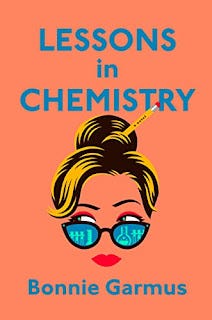
Lessons in Chemistry
Bonnie Garmus
This book needs to decide what it wants to be when it grows up
When I first began thinking about reading Lessons in Chemistry I got seriously mixed signals from reviews and the publisher's blurb. On the one hand a lot of people seemed to think it was a serious look at the disadvantages women scientists operated under in the late 1950s/early 1960s. On the other hand, a lot of people seemed to think it was a deplorably unserious look at that subject. Yet others described it as delightful and fun. And others thought the characters were shallow and the plot lacking.
The reason for all this ambiguity is, I think, straightforward -- Bonnie Garmus didn't know when she began what kind of book she wanted to write. She began, apparently, with the idea that it was going to be a serious look at women in science in the late 50s. But as she tooled along, it turned into a fantasy that is, at times, whimsical and a lot of fun, but never really burdened with accurate facts about science or even life in the 50s. And that, I think, is the best way to read it.
As an example, my favorite character is called Six-Thirty. I am not going to tell you who or what Six-Thirty is. But he's totally unbelievable and at the same time tremendous fun. Most of the characters are indeed paper-thin, and the plot is mostly nonsense. And yet, it's fun.
As an example of Garmus's failure to capture the actual Zeitgeist of the time she wrote about, Sputnik doesn't get a mention. In 1957 the Soviet Union launched a small satellite into orbit. The USA and western nations went into a full-blown panic that lasted for several years. They had all thought that the USSR was a scientifically backward nation years away from such an accomplishment. (It is not irrelevant that the engineering necessary to put a satellite in orbit is not very different from that necessary to build a missile that can deliver a nuclear warhead anywhere on Earth.) As a result of this panic scientists briefly became folk heroes. They were revered, and schools were revamped to educate more scientists. The USA got an expanded space program. Did this create opportunities for women scientists? It did! Pitifully stingy and constrained ones, but Not Nothing. The consequences of Sputnik would have been extremely relevant to Garmus's hero Elizabeth Zott and to the education of her daughter Mad.
If you actually want to know what science was like for a woman in and before those times, here are some suggestions:
Through a Window: My Thirty Years with the Chimpanzees of Gombe, In the Shadow of Man, and Africa in My Blood, by Jane Goodall.
A Feeling for the Organism: The Life and Work of Barbara McClintock, by Evelyn Fox Keller.
Hidden Figures, by Margot Lee Shetterly. (This was made into an excellent film.)
Dorothy Crowfoot Hodgkin: Patterns, Proteins and Peace: A Life in Science by Georgina Ferry. A chemist like Elizabeth Zott, Dorothy Hodgkin would be the best antidote to Lessons in Chemistry.
So here's my take on Lessons in Chemistry: read it, have fun with it, but for God's sake don't take it seriously.