

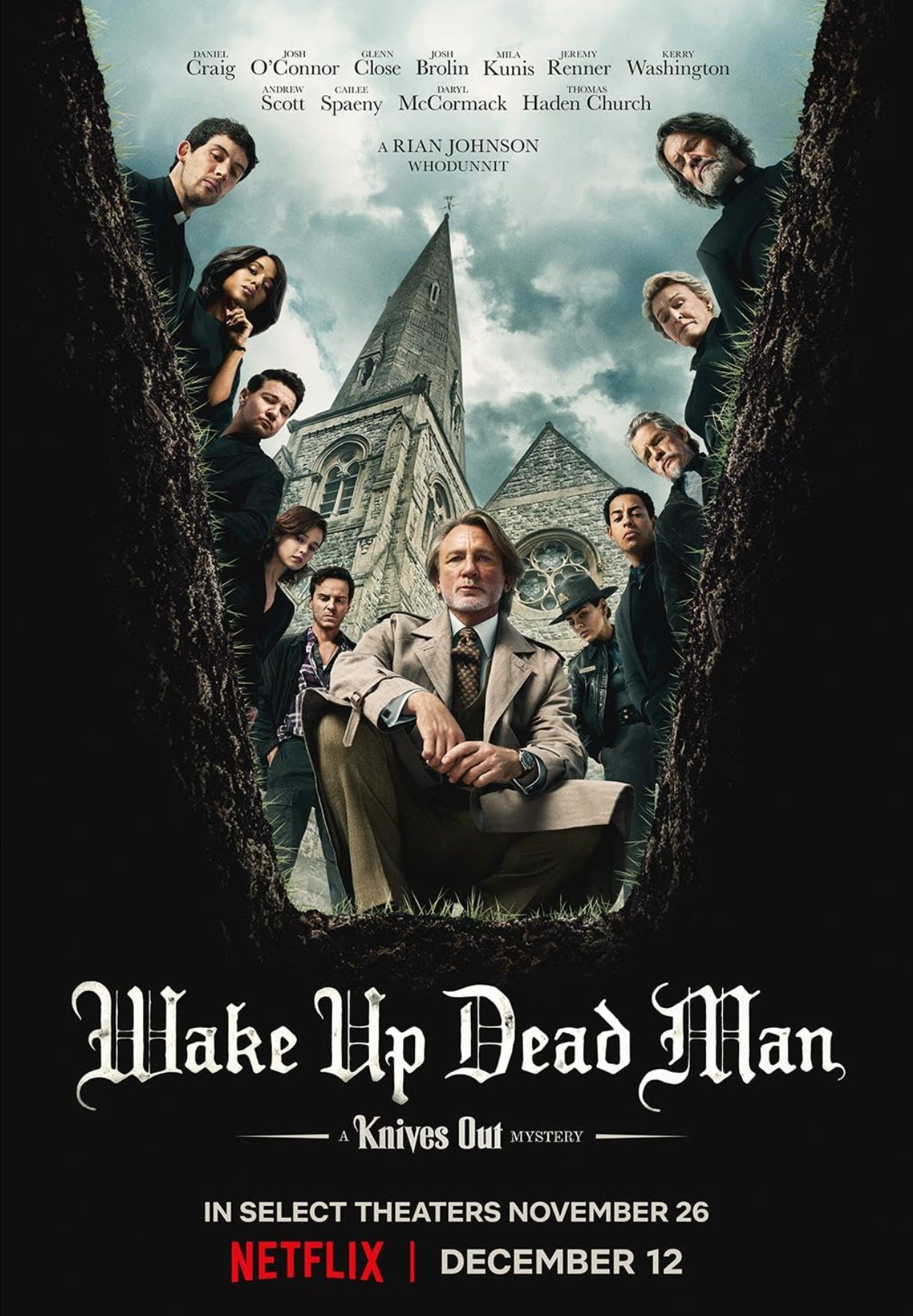
Wake Up Dead Man: A Knives Out Mystery
Directed by Rian Johnson
Wake Up Dead Man is the third in the Knives Out series of mystery movies, now a Netflix property. They are all good. If you said to me, “This is the best of the three,” I wouldn’t argue. They’re smart, they feature good actors, and they make you feel good by laughing at people who deserve to be laughed at. In the first, Knives Out, after which the series is named, a wealthy mystery author dies. His relatives, who have for the most part been leeching off him for years, hope to inherit. They are a contemptible bunch, and a good deal of the movie’s fun comes from the way they are held up to ridicule. The second, Glass Onion features a grotesquery of sycophants surrounding an obscenely wealthy tech entrepreneur Miles Bron. Once again, much of the fun of the film comes from laughing at the fools.
Thus I thought I knew what to expect in Wake Up Dead Man. Indeed, one or two reviews I looked at mentioned how funny it was. But it wasn’t, not really. I mean, yeah, there were some laugh-out-loud funny moments. But most of the time I didn’t feel like I was watching a funny movie.
This time, the fools at whom we laugh are not wealthy people, but rather people connected with a Roman Catholic Church congregation in upstate New York. The church’s pastor, Monseigneur Jefferson Wicks, is murdered at the Good Friday service in the presence of the most devoted members of his congregation. Suspicion immediately falls on his young assistant priest, Reverend Jud Duplenticy, played by Josh O’Conner. Detective Benoit Blanc shows up and offers to help him. Of course, in the course of the investigation we learn about Mons Wicks and the principle members of his congregation, who all have their problems, and so we do, indeed, get to laugh at some people who deserve it.
But compared to the previous two Knives Out films, there’s a new element in this one: earnestness. Jud Duplenticy is a truly good man (in this regard he recalls nurse Marta Cabrera in the first Knives Out). He has a genuine vocation for the priesthood, which he explains so well that even the atheist Benoit Blanc is won to admiration. I felt that Christianity (as it should be, not necessarily as it actually is) is presented unironically as a Good Thing.
The vehicle for this earnestness is O’Conner is his role of Duplenticy. I had never heard of O’Conner or seen him. (This is meant not to imply that he is little known, but that I am ignorant.) I was impressed. He dominates every scene he appears in (even in the presence of Daniel Craig, Glenn Close, Josh Brolin, Jeremy Renner, Kerry Washington, Andrew Scoot, and Daryl McCormack), and he is in most scenes.
I thought this broadening of the formula worked well. Having a character to admire and to root for in addition to all the laughable Pharisees made it bite deeper.