

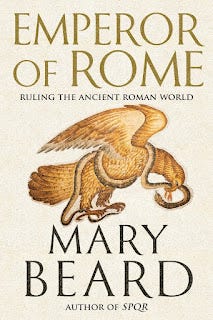
Emperor of Rome: Ruling the Ancient Roman World
Mary Beard
What we know about what we know about the Emperor
Emperor of Rome: Ruling the Ancient Roman World is the second book by Mary Beard that I have read -- the first was SPQR: A History of Ancient Rome. I have, however, read a bunch of books about Roman history. (I think the first was Isaac Asimov's The Roman Republic, which I read as a high-school student sometime in the 1970s.) Beard's work is quite distinct from most Roman history for popular audiences, though, because instead of telling you "This happened, then this happened, then this..", she tells you "Here are our sources of information. This is what they may mean."
SPQR focused more on the Roman Republic than the empire. And by far the main lesson was, "Our sources are scanty... We really don't know for sure much of anything about the early history of Rome. Most of what other popular historians claim to be certainly true is probably wrong." Emperor of Rome, though is different, because there are vast troves of documents, inscriptions, and works of art from the Roman Empire, and much of that corpus focuses on the Emperor. Thus Emperor of Rome has a bit the feel of "lamppost science", which comes from an old joke about looking for your keys where the light shines, even if you know you lost them somewhere else. Beard makes it clear that she is not more interested in the Emperor himself than in any other Roman, but that she is using his prominence as a light to illuminate the rest of the Romans.
On 1-Sep-100 the prominent Roman Pliny made a speech in the Senate praising then-Emperor Trajan. A written record of this speech survives, now known as the Panegyric. In it Pliny paints a comically flattering portrait of the Emperor. Beard uses this information cleverly. She doesn't take it as anything close to an accurate character sketch of Trajan. Pliny is telling Trajan what he thinks Trajan wants to hear. But there's a pony in there! The Panegyric reveals what Pliny thinks Trajan wants to hear! It reveals what the Romans thought an ideal Emperor ought to be. That is, in its own way, more interesting and useful information than knowing the personality of one Emperor.
Perhaps Beard's strongest conclusion is that the Emperor's main job was to put on a show. In an epilog, she writes
Autocracy ... upturns the 'natural' order of things and replaces reality with sham, undermining your trust in what you think you see.
I have often insisted that ancient Rome has very few direct lessons for us, in the sense that we cannot turn to it for ready-made solutions to our problems. The Romans will not, and cannot, give us the answers. But exploring their world does help us to see our own differently. While I have been writing Emperor of Rome over the last few years, I have thought hard about the view of autocracy as fundamentally a fake, a sham, a distorting mirror. It has helped me to understand ancient Roman political culture better -- and has opened my eyes to the politics of the modern world too.
I thank NetGalley and W. W. Norton & Company for an advance reader copy of Emperor of Rome: Ruling the Ancient Roman World. This review expresses my honest opinions.