

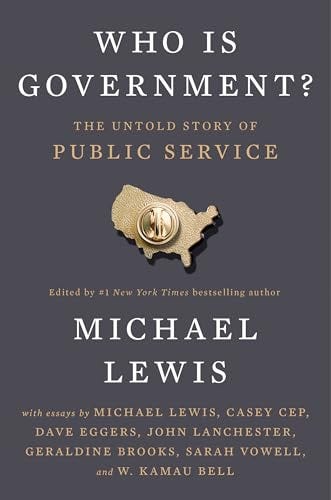
Who is Govermnent?
Michael Lewis, Casey Cep, Dave Eggers, John Lanchester, Geraldine Brooks, Sarah Vowell, and W. Kamau Bell
Real people doing real work
Confession: I worked for government for my entire working life. Yes, I am one one of those Deep State Government Workers of whom you have heard so many awful things. More specifically, I worked as a professor at two state universities.
"But that's not what we mean by "government workers!" you say. It is! The largest category of government workers are teachers of one sort or another. There are millions of us! Every member of my immediate family has worked for the government. My father was in the Navy for a couple years, and my mother and two sisters were all teachers. One of my nephews works for a town in Upstate New York: emergency services and road work. Another is in the army -- he also has lately become a teacher of sorts, training his fellow soldiers. One of my nieces is a nurse in a Veteran's Administration hospital.
My point is, I did not need this book. I know who government is: it is me and my family and coworkers: real, hard-working people who teach and save lives and even teach people to save lives.
And yet, I enjoyed it and learned from it. Its eight chapters were written by Michael Lewis, Casey Cep, Dave Eggers, John Lanchester, Geraldine Brooks, Sarah Vowell, and W. Kamau Bell. Lewis, who also edited the collection, wrote two chapters, the other authors wrote one chapter each. Each chapter focuses on one specific bit of the US Federal Government: the Bureau of Mines, the National Cemetery Administration, the Jet Propulsion Laboratory (rocket scientists!), the Bureau of Labor Statistics, the Internal Revenue Service, the National Archives, the Department of Justice, and the Food and Drug Administration (which Lewis calls the Department of Ingestion). No teachers here: people whose job title contains the word "teacher" are generally found in local government, not the Feds. Yet, many or all of the people here are teachers of one sort or another in practice.
Each of seven of the eight chapters profiles one or a few Federal employees. The exception, "The Number," by Lanchester, stars a number: the Consumer Price Index.
The unfortunate thing about this book is that the people who need it most will not read it. I almost guarantee that you will learn something you didn't know from it.