

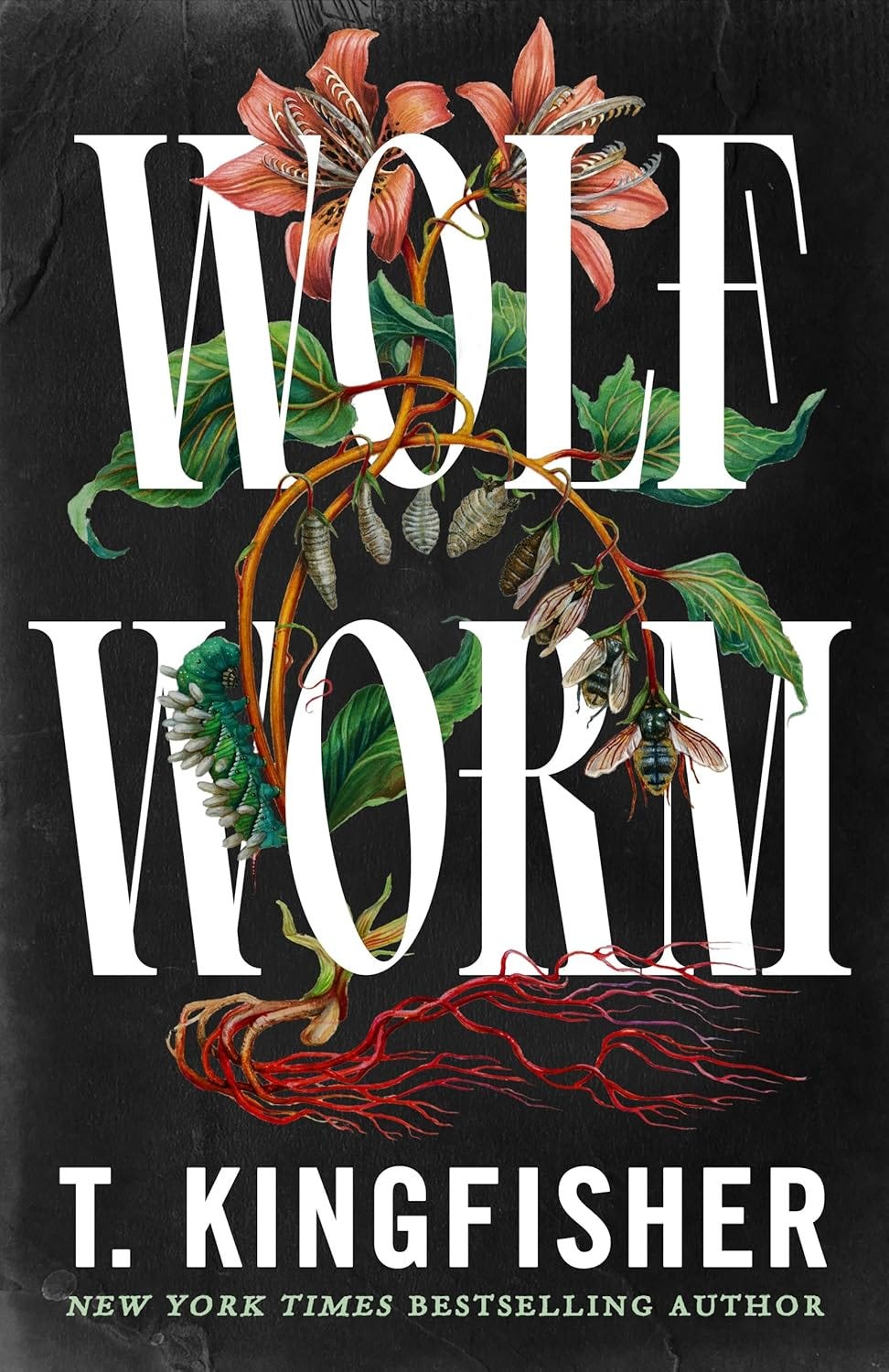
Wolf Worm
T Kingfisher
Horror = terror + disgust?
You’re probably asking yourself, “What is a Wolf Worm?” unless, of course, you assumed it was just some fictional thing that T. Kingfisher made up. Turns out, it is not. It’s a colloquial name for a Botfly infestation. Quick précis for those who don’t want to read Wikipedia: a botfly is a kind of parasitic insect. It lays its eggs on an animal. The eggs hatch into larvae that get inside -- under the skin, in the guts, somewhere -- through any aperture they can. They they eat the animal’s flesh and grow until it’s time to leave and turn into a fly.
Of all the real things in nature that might provoke the emotions of horror, there is, to my mind, no better candidate than parasitic insects. So horrified was Charles Darwin by ichneumon wasps that he questioned his religion
I cannot persuade myself that a beneficent and omnipotent God would have designedly created the Ichneumonidæ with the express intention of their feeding within the living bodies of Caterpillars.
I propose that well-done horror provokes a combination of two emotions, disgust and terror. Disgust -- gross-out, squick -- whatever you call it, is something that everyone recognizes. Terror is harder to explain, but Stephen King (natch!) has done it well:
Terror, when you come home and notice everything you own had been taken away and replaced by an exact substitute. It’s when the lights go out and you feel something behind you, you hear it, you feel its breath against your ear, but when you turn around, there’s nothing there...
The problem with most horror I read is that the authors don’t realize that these are different things. Terror is hard, so poor horrorists often rely almost exclusively on disgust. They compound this problem by thinking that perfectly ordinary biology is disgusting.
Kingfisher (aka Ursula Vernon) is good at horror. She understands the difference between terror and disgust and is capable of managing both.
Sonia Wilson is a talented painter. Her father was a naturalist, and she illustrated his works. Since his death she has had to earn her own living -- not an easy thing for a young single woman in the post-Reconstruction South. She’s been teaching art at a girl’s school the last several years. She naturally dreams of finding a situation that allows more scope for her talents. Thus she has come to the Carolina woods to work for entomologist Dr. Matthias Halder, painting illustrations of his collection of parasitic insects. Halder is an unpleasant dude, but at first he seems to be on the up-and-up.
Sonia has that besetting problem of characters in horror novels: an unhealthy degree of curiosity1. Halder has dangerous secrets, of course, and Sonia finds out too much. [spoiler2]
I am not, myself, a huge fan of horror, but I enjoy seeing any difficult thing done well. Wolf Worm evokes that mixture of terror and disgust that made my flesh crawl. If you enjoy horror, I recommend it.
Thanks to NetGalley and Tor for an advance reader copy of Wolf Worm. Release date 24-Mar-2026.
I don't by any means want to suggest that curiosity is a bad thing. But if you have reason to believe that you are a character in a horror novel, you might do well to suppress it.
He is studying botfly infestations of vampires -- that's the short version
Excellent review! 💯
And I’ve never thought about the horror genre like that before, with the terror and disgust both being important parts of it; but I can see how those elements both tend to be pretty heavily employed in effective horror stories. ⚖️
Thank you for sharing this review with us readers! 🙏
Kingfisher's been a little hit or miss for me lately but this one sounds promising. I much prefer horror that focuses on terror rather than disgust which sometimes makes it difficult for me to find horror I can enjoy.