

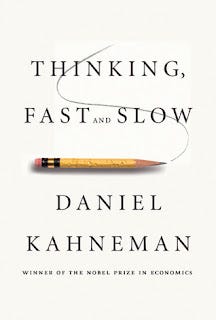
Thinking Fast and Slow
Daniel Kahneman
You don’t think the way you think you think
I just realized that I had somehow never written a review of Thinking, Fast and Slow. It's a tremendously important book. Here's why:
When someone asks you "What were you thinking?", the answer you give is almost certainly a falsehood. Not a lie -- you believe it when you say it. But it is a fabrication. Your answer is couched in words, and usually bears some passing resemblance to logical thought. But that is not how we think most of the time. The activity we think of when we use the word "thinking", stringing words together in our minds in such a way as to construct Aristotelian syllogisms, is an effortful strain that our brains can barely manage. It is what Kahneman calls "System 2".
Most of our thinking, however, is done by System 1, which is much quicker and feels effortless. (It gave rise to the title of Malcolm Gladwell's Blink, which is, IMO, an inferior popularization of the work Kahneman describes here. Typically you are unaware that you are using System 1.)
We have System 1 because we have to make decisions and act much faster than we can with our clunky and barely functional logical reasoning System 2. System 1 is mostly heuristic -- that means it is based on shortcuts. A small furry pet that your neighbor owns is probably a cat -- a bigger one is probably a dog. Now you're all lining up to tell me why that's wrong. And you're right -- it is wrong. It could be a hamster or a leopard, if your neighbor happens to own exotic pets. A cat can be bigger than a dog. But most of the time "dog or cat" is a great guess, and if you proceed on the presumption that the pet is a dog or cat, you'll probably do the right thing. (The word "probably" is doing important work there -- it's what makes the sentence true despite the possible leopard.)
There is another reason why System 1 is dangerous: the heuristics it uses evolved through our millions of years of history as wild animals. The heuristics that worked for African plains apes -- "sugar and fat yummy, do what tall man says, impress pretty girl" are often terrible guides to action in the complex technological societies we now inhabit.
In 2002 Kahneman shared the Economics Nobel Prize with Vernon Smith for showing that humans make irrational economic decisions. This may not seem like much of an insight -- if you've ever talked with, really, just about anyone, about their purchases, you have probably seen irrational economic decision-making in action. But for centuries the discipline of Economics was largely based on the assumption that humans are rational utility-maximizers. (And it still is.)
System 1 is the source of much or our irrational decision-making. In addition, it doesn't help that most of us are really lousy at thinking logically. Even when we summon up the effort to kick System 2 into gear, our thinking is riddled with logical fallacies. This is not really Kahneman's topic. But since many of these logical fallacies are heuristics imported into System 2 from System 1, Kahneman will help you understand them.