


The Forbidden Tree
Continued from

Epigraph
Vermissen werde ich nimmermehr
Die paradiesischen Räume;
Das war kein wahres Paradies—
Es gab dort verbotene Bäume.
—“Adam der Erste”, Heinrich Heine

Nevermore will I prize
Eden far and fair;
The garden was no true Paradise—
Forbidden trees were there.
—“Adam der Erste”, Heinrich Heine (tr Brok3n Engines)
The Forbidden Tree
“Uncle Akela! Wanna see a puzzle about numbers?”
Without waiting for his answer, Adam grabbed his hand and dragged him over to where Maya sat at a table. There was a bowl of popcorn on the table. Maya picked up a few pieces and put them on the table.
“OK, you have to share that little heap of pieces of popcorn. You have to divide it up into smaller heaps.”
“And,” Adam said, “there are two rules. First each of the smaller heaps has to have more than one piece in it. Second, the smaller heaps all have to be the same size.”
Akela looked at the little heap Maya had placed in front of him. There were six pieces of popcorn in it. He divided it into three groups of 2 pieces each.
“Now look,” Adam said. He took one piece out of the big bowl and added it to the six in front of Akela.
Akela divided the seven into 3 pairs and one, then two heaps of three and one. “I can’t do it,” he said.
“It’s impossible to share seven according to the rules,” said Adam.
“You can share four, or six, or eight,” Maya added. “We call those sharing numbers. You can’t do three or five or seven. Three, five, and seven are not sharing numbers.”
“Is it just non-sharing, sharing, non-sharing, sharing, …?” Akela asked.
“No,” said Adam. “Watch this.” He took two more pieces out of the bowl and added them to the seven already there, making nine. Then he arranged them in three groups of three.
“You see,” Maya said. “Nine is a sharing number. So is ten. There are three sharing numbers in a row: eight, nine, ten.”
“These are deep waters,” Akela said solemnly.
Adam and Maya looked at him, annoyed that he was making fun of them.
“No, really!” Akela said. “This is a serious mathematical puzzle. It reminds me of a story.”
“Is it a story you can read to us?”
“No, this is not a story in a book. It’s a story of my own.”
“Can you tell us?”
“I can try. But I’ve never told it before. I’ll have to think about it as I tell it.”
“Tell us!”
There was a map of the Earth on a poster on one wall of the room. Akela placed his hand in the middle of the USA and asked, “You know what this is, right?”
Adam answered, “That’s America.”
“That’s right. And we’re here, where it says Boston.” He placed his hand over France and Germany. “And this?”
Maya said, “I don’t know what country that is, but I think that’s called Europe.”
Akela said, “Yup! And now this big blue space between them.”
“Well, that’s easy,” said Adam. It’s written right on it in big letters. Att-lan-tick Okk-ee-ann”
Maya, who was two years ahead of him in school, helped him out: “Atlantic Ocean.”
Adam was getting ready to argue that “O-C-E-A-N” could not possibly be pronounced that way, but Akela told him, “She’s right, actually. That’s how O-C-E-A-N is pronounced. But you’re also right, Adam—the way it’s written makes no sense. You just have to know that O-C-E-A-N is Ocean. That’s the Atlantic Ocean. When you go to the beach, that’s what you swim in.”
“And it goes all the way to Europe?”
“It does now,” Akela answered. But according to a long-ago Greek scientist named Plato, there used to be a continent here,” placing his hand on the eastern Atlantic ocean just west of the Strait of Gibraltar. “It was called ‘Atlantis’ because its king was Atlas. He was the son of Poseidon, the God of the Sea. Poseidon owned Atlantis, and he gave it to his son for his kingdom.”
“Is that true?” Adam asked skeptically.
“It’s true that there was a real Greek scientist named Plato who lived two thousand years ago. And it is true that he wrote about the lost continent of Atlantis in two of his books.”
“How could a continent get lost?” Adam persisted.
“Well, that’s what the story is about. That’s one thing the story is about.”
Akela continued, “There was a great forest on Atlantis. It was called the Grove of Poseidon. It had all kinds of especially beautiful and tall trees. Animals lived in the forest. The animals in Atlantis were wise, and they could speak to each other and to humans, like the talking animals of Narnia. Even the trees could talk.
“There was a toad named Kaeru and a snake named Hebbi, and they were friends.”
“Don’t snakes eat toads?” Adam asked.
“Some snakes eat toads, you’re right. But Hebbi was a green snake. Green snakes eat bugs. Hebbi was too small to eat something as big as a toad.”
“Toads eat bugs, too, right?” Maya asked.
“Yes, they do. I don’t know if all toads eat bugs, but Kaeru did,” Akela answered.
“So could Kaeru and Hebbi eat together?”
“Maybe. I’m not sure. Toads and snakes don’t eat meals the way we do—they don’t sit down to a table and eat a plateful of bugs. They have to catch their food. So I’m not sure if Hebbi and Kaeru could eat a meal together.”
“So, what did they do together?”
“They studied, and they talked with each other.”
“What did they study?”
“Oh, all kinds of things. Anything they were interested in. You see, everyone in Atlantis, all the humans and all the animals, was a scholar.”
“What’s a scholar?” asked Adam.
“Oh, I know that,” said Maya. “A scholar is a person who studies something and knows a lot. Like a college professor.”
“But a snake can’t be a college professor. Or a toad,” said Adam.
“Well, maybe they could in Atlantis,” said Maya.
“No,” said Akela. “Atlantis didn’t have colleges like ours. Instead they had the Grove of Poseidon. But what Maya said first is right. A scholar is someone who studies things, because they want to know about them.”
“What did you mean when you said they had the Grove of Poseidon instead of colleges like ours?” Adam asked. “Did they study in the forest?”
“Yes, exactly,” answered Akela. “Remember I told you even the trees could talk in Atlantis. The trees in the Grove of Poseidon were wise and knew all about everything. Each tree knew about one kind of thing. If you wanted to study a thing, you would find a tree that knew about that and ask it questions.”
“What did Hebbi and Kaeru study?” Adam asked.
“Hebbi was really interested in numbers. That’s why your puzzle about sharing numbers reminded me of Atlantis. You see, most people don’t realize that numbers come in different types. But they do, as your puzzle showed. Hebbi was really interested in that.”
“Did he’’—
“—She—” interrupted Akela.
“Did Hebbi understand sharing numbers?”
“She may have,” Akela answered. “When you think about numbers, it is very likely that different people will have the same ideas. That’s one thing that makes numbers special: they’re the same for everyone.”
“Was Kaeru interested in numbers, too?” asked Maya.
“Well, he was, but not as much as Hebbi. Kaeru was more interested in politics.”
“Mommy and Daddy hate politics,” Adam said.
“Yes, well that’s kind of what Kaeru was interested in. He wanted to find a way to make politics work better, so that people didn’t hate it.”
”But,” said Adam, “the things Hebbi was interested in and the things Kaeru was interested in are completely different. What did they talk about?”
“Well,” Akela answered, “Hebbi and Kaeru thought that maybe politics could be more like math.”
“I don’t understand,” Maya said.
“Neither do I,” admitted Akela. “But that’s what they hoped to figure out—a way to make the same politics work for everyone, the way that the same numbers work for everyone. Maybe they were wrong, but it was what they hoped for.”
“That just sounds crazy,” Adam said.
“Yeah, but maybe not so crazy in Atlantis as here. The people of Atlantis were mostly happy, most of the time. They didn’t hate politics so much. So, Kaeru and Hebbi studied together in the grove. Hebbi knew which trees knew the most about numbers, and Kaeru knew which trees knew about politics, and they would go from one tree to another, asking their questions.
“One day as they were searching the forest, they came on a tree they had not seen before. It was a giant, beautiful tree, but It had a fence around It. They had never seen a tree with a fence around it. In fact, fences were unusual in Atlantis—people were mostly free to go where they wanted. And this was an ugly fence, made of iron bars with sharp spikes on top.
“From outside the fence, they shouted at It, ‘Why do you have a fence around you?’”
“The tree answered, ‘I am the Forbidden Tree. I hide a secret under my roots. You should go away now.’”
“How far apart were the spikes the fence was made of?” Maya asked.
“They were a few inches apart,” Akela answered.
“So a snake could crawl between them?” Adam asked.
“Exactly what Hebbi thought!” said Akela. “In fact, Kaeru thought he could easily hop right through the fence, too.
“They went away, but they came back that night. Kaeru hopped through the fence, and Hebbi slithered under it.”
“Although they were quiet, the tree noticed them. ‘You are the two who spoke to me earlier, aren’t you?’
“‘Yes,’ Kaeru answered. ‘Why is your secret forbidden?’
“‘It would be the end of Atlantis if it was known,’ the Forbidden Tree answered.”
“They have to learn the secret,” Adam said.
“Adam is right,” Maya said. “Mommy says the truth will always come out, and we should always live by the truth.”
Akela said, “That’s what Kaeru and Hebbi thought.
“Kaeru said to the Tree, ‘What if we promise not to tell?’
“The Tree answered, ‘If you know the secret, it will be the end of Atlantis for you.’
“Hebbi said, ‘You say the secret is hidden under your roots?’
“‘Yes,’ said the Tree.
“Green snakes can burrow. Hebbi began digging down between the roots of the Tree. Some toads can burrow, too. Kaeru was not good at it, but he followed, making Hebbi’s hole bigger with his strong hind legs as we went. Hebbi dug a long way, about six feet down, but angling towards the center of the tree. And then, to his surprise, he fell. He had come out into a room under the Tree. Kaeru fell out behind him.
“They were in a dirt room, about the size of this room. And they were not alone. There was a little old man there: very little and very old.
“‘Aha!’ said the old man, “Visitors!’
“‘Do you often have visitors?’ Kaeru asked.
“‘No,’ the old man answered. The last came more than a year ago. And no one visits more than once.’
“‘Why not?’ Hebbi asked.
“‘You will find out.’
“‘Who are you?’ Kaeru asked.
“‘I’m the King,’ the old man answered.
“‘What are you the King of?’Kaeru asked.
“‘Atlantis! Said the old man.
“‘But,” said Hebbi, ‘We’ve seen the King. He’s a big handsome man. He wears beautiful white armor and rides a white stallion. You are not him.’
“‘Indeed,’ said the old man, ‘You are right. Atlantis has two kings—the Light King and the Dark King. The man you describe is the Light King, who everyone knows. When the people of Atlantis are happy, he shares their joy. I am the Dark King. When the people of Atlantis hurt, I take their pain to myself. That’s why I’m small and old.’
“‘That seems really unfair,’ said Kaeru.
“‘It is that,’ said the Dark King.
“‘Why, then, do you allow it?’ asked Kaeru.
“‘Some people think that it’s a good trade: the suffering of one person for the happiness of an entire nation.’
“‘What do you think?’
“‘I hardly know. More important, what do you think? You have a decision to make. Your visit here can end in two ways. Either I take away your memory of this visit and you are free to go back to your normal lives. Or you can leave Atlantis, never to return.’
“Kaeru asked, ‘What have other visitors decided?’
“‘I can only tell you that some visitors chose oblivion, and others chose exile.’”
“What’s oblivion?” Adam asked.
“Oblivion means forgetting,“ Maya answered.
“And what is exile?”
“Exile is being sent away and not allowed to come back.”
“Why would anyone choose that?” Adam asked.
“I think I might,” said Maya. “Would you want to stay if you knew that the land you lived in hurt an old man?”
“Oh!” said Adam, eyes widening.
“Kaeru and Hebbi argued about it for almost an hour. Finally they told the Dark King, ‘We choose to remember.’
“‘So be it,’ he answered. ‘Atlantis is closed to you now. I will send you away.’
“He waved his hand, and they floated up. They floated up right through the dirt ceiling of the Dark King’s little room, as if they were ghosts. They floated through the trunk and branches of the Forbidden Tree, and then they continued to rise until they were so high above Atlantis that they could see the whole of it.
“Then, as they watched, there was a great roar, and Atlantis shook. It shook until it broke into many small pieces. They saw these pieces sink beneath the sea. Toads and snakes don’t cry the way we do, but they grieved to see their home, the land where they had lived and been happy all their lives, destroyed.
“The air carried them east to Europe. And when they looked west to where Atlantis used to be, it was gone. In its place was the Atlantic Ocean.
“And that is how Atlantis fell.”
“I don’t understand,” Adam said. “Atlantis was destroyed! That’s not one of the things the Dark King told them could happen. They didn’t know that if they chose to remember, it would destroy Atlantis. And all the people would be drowned!”
“And another thing,” said Maya. “The Dark King told them other visitors had chosen exile. But Atlantis had not been destroyed before Kaeru and Hebbi visited the Dark King.”
They looked at Akela doubtfully.
“Was Atlantis really destroyed when Kaeru and Hebbi were exiled?” Adam asked him.
“Maybe the Dark King didn’t really destroy Atlantis,” said Maya. “Maybe that was just a picture he showed them when he kicked them out, so they would know they couldn’t come back.”
“Is Atlantis really gone?” Adam asked.
“I don’t know,” Akela asked.
“But you told us this was a story of your own,” Adam said. “You have to know!”
“I’m sorry, Adam. I don’t know.”
“But it’s your story! Can’t you just decide?”
“No, Adam, I can’t just make the story do whatever I want. Even though it’s my story.”
“I don’t understand,” said Adam.
“I don’t either,” answered Akela. “That happens when you tell a story. Sometimes it takes on a life of its own.”
“What do you believe?” Maya asked.
“I think Atlantis still exists in some form, and if you look in the right way can still find it. And I see we’ve eaten all the popcorn, so the story is over.”
Adam glowered at him, still unsatisfied.
Ruth and Isaac came to take them to bed.
A few minutes later, Akela took his leave at the door.
“Wow! You have two scary-smart kids. Do you know they discovered prime numbers?”
“That would be Adam,” Isaac answered. “They’re both smart, but Adam is the mathematician.”
“I’m pretty sure I was not that smart when I was their age,” Akela said.
“I’m pretty sure you were,” said Ruth. “Good night, and thanks for coming.”
Afterword
This story began with the story “Atlantis: A Nomance,” which ended with Akela telling Ruth and Isaac’s children stories of Atlantis. I thought I would write down one of those stories. I had fun recreating the scene of Akela telling a story to two lively and very intelligent kids.
It was additionally inspired by a verse from “Adam der Erste” (“Adam the First”) by Heinrich Heine,
Vermissen werde ich nimmermehr
Die paradiesischen Räume;
Das war kein wahres Paradies—
Es gab dort verbotene Bäume.
—“Adam der Erste”, Heinrich Heine

Nevermore will I prize
Eden far and fair;
The garden was no true Paradise—
Forbidden trees were there.
—“Adam der Erste”, Heinrich Heine (tr Brok3n Engines)
…with apologies for my crude English translation.
The stories of Atlantis (as described in Plato’s Timaeus and Critias), the story of Adam and Eve from Genesis, and Ursula LeGuin’s The Ones Who Walk Away from Omelas all got chopped up and mixed together in the story that Akela tells Adam and Maya.
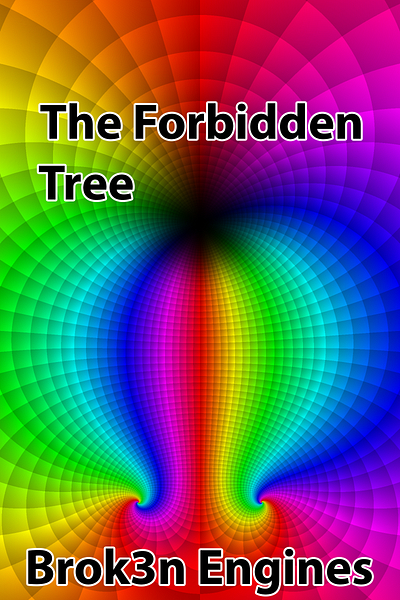
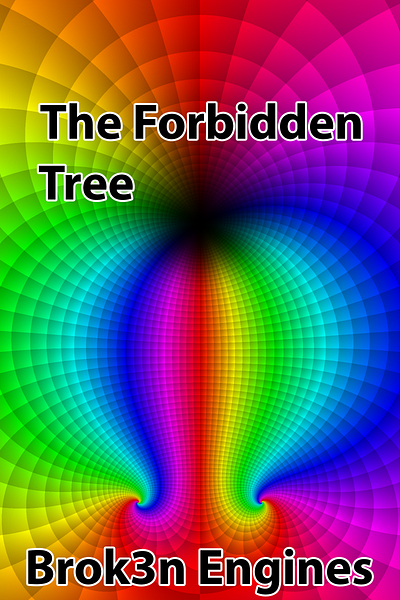
The cover image is a phase portrait of f(z):

A phase portrait is a visualization of a complex function introduced by Elias Wegert in Visual Complex Functions: An Introduction with Phase Portraits. I modified the color mapping so that the root representing the Dark King would be black.
Such an amzing piece. Very intresting!
Excellent storytelling! 💯
And I love how he says “I don’t know.” in answer to a question about a story of his own, and I like that he sticks to it when further questioned.
I tend to have that perspective about stories that I write. Unless it’s actually written down in a story that I’ve published I tend to say something along the lines of I can have theories or think something is more or less likely, but I generally try not to say definitively. I also like when an interpretation that I have of a story that I’ve written is different from an interpretation that someone else has.
As Akela said, “That happens when you tell a story. Sometimes it takes on a life of its own.”
So fun to see that concept that I really like in this story!
Thank you for writing this story and for sharing it with us readers! 🙏